Mr. Thoroughgood
Black BeautyMr. Thoroughgood is the gentleman farmer who rescues Black Beauty from a sale of worn-out horses and gives him the rest and care needed to recover. His importance lies not simply in buying the horse, but in treating recovery as a responsibility: he provides a meadow, assigns Willie to oversee him, watches for improvement, and ultimately seeks a quiet home where Black Beauty will be valued rather than worked beyond his strength.
Identity and First Appearance
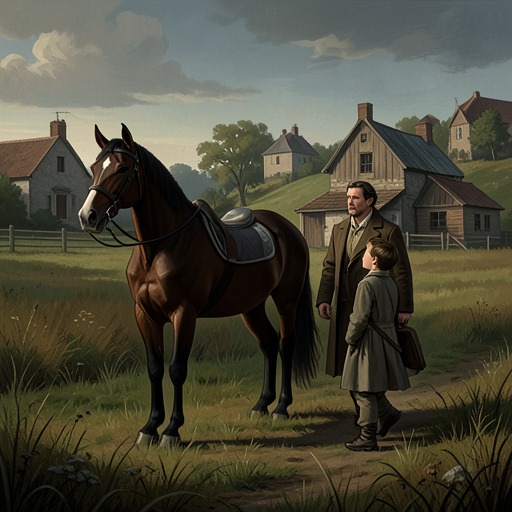
Mr. Thoroughgood first appears at a sale where old, lame, and otherwise worn-down horses are being traded. The people bargaining over them are themselves often poor: some hope to find a horse for a small cart, while others sell an exhausted animal because killing it would mean a greater loss. The scene places his decision within a market shaped by hardship, but distinguishes him from buyers concerned only with what a failing horse can still earn. He is described as resembling a gentleman farmer, with broad shoulders, a ruddy face, and a broad-brimmed hat. As he looks over the horses, he pauses with a pitying expression; his attention settles on Black Beauty, whose good mane and tail still give him a chance of attracting notice.
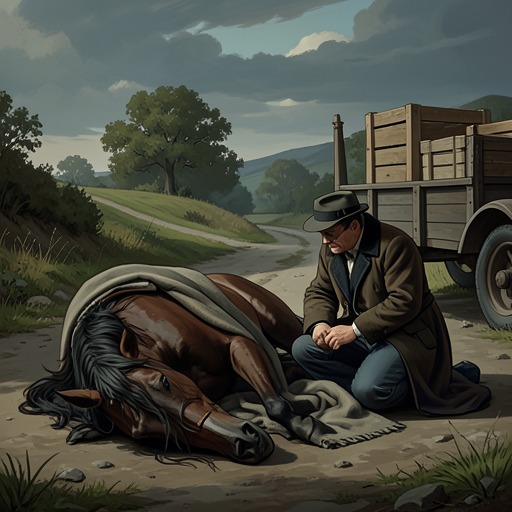
Mr. Thoroughgood does not encounter a horse presented as ready for ordinary work. Black Beauty is weak after overwork in cabs, and the seller reports that a veterinary surgeon believes six months of rest could restore him because his wind is not broken. The seller also describes him as pleasant and grateful to handle, and argues that giving him a chance may prove worthwhile. The account offers Mr. Thoroughgood a reasoned prospect rather than a guarantee: recovery depends on time, and the horse’s future remains uncertain.
The Decision to Give Him a Chance
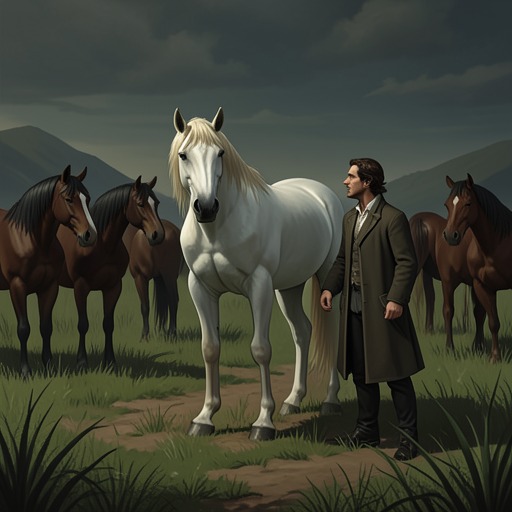
Willie urges his grandfather to look at Black Beauty’s mouth and ask the price, believing that the horse could grow young again in their meadows. His appeal helps turn the old gentleman’s attention into a decision. The seller’s estimate of possible future value forms part of the exchange, but the scene stresses the more immediate question of whether the horse will be allowed the rest that his condition requires. Mr. Thoroughgood buys him rather than leaving him among the other spent animals at the sale.
The journey home begins with a stop at an inn, where Black Beauty is given a good feed. A servant then rides him gently to his new master’s property and turns him into a large meadow with a shed in one corner. The setting marks an abrupt change from sale-yard uncertainty to a place where he can be left to recover. Mr. Thoroughgood’s purchase is therefore the beginning of a period of care, not an immediate return to labor.
Recovery and Willie’s Charge
Mr. Thoroughgood orders hay and oats every night and morning and gives Black Beauty the run of the meadow during the day. He places Willie in charge of him, making the boy’s affectionate concern part of the practical arrangement for his care. Willie accepts the duty seriously and visits every day. Sometimes he brings a carrot or another good thing to eat; sometimes he simply stands beside Black Beauty while he has his oats. The horse comes to recognize this steady attention and grows fond of him. Willie calls him Old Crony, and Black Beauty begins to follow him about the field.
The grandfather’s care is attentive as well as generous. He accompanies Willie to see the horse and looks closely at his legs, monitoring the very areas that matter to his condition. Over time, he observes that Black Beauty is improving steadily. By summer, he judges that the horse can begin a little gentle work, and expects that by mid-summer he may be as good as Ladybird. He also recognizes the quality that remains beneath the exhaustion: Black Beauty has a beautiful mouth and good paces. The gradual sequence—from daily pasture and regular feed, to observed improvement, to limited work—shows that Mr. Thoroughgood does not treat renewed strength as permission to hurry the horse back into hard service.
Seeking a Valued Home
As Black Beauty improves, Mr. Thoroughgood’s aim extends beyond keeping him at the farm. He tells Willie that the horse owes his chance largely to the boy’s insistence, and that they must find him a quiet, genteel place where he will be valued. That intention is confirmed when the groom prepares Black Beauty with unusual care for an outing: his fetlocks and legs are trimmed, his hooves brushed, and the harness polished. Willie is both anxious and cheerful as he rides with his grandfather in the chaise.
They travel a mile or two from the village to a low house with a lawn and shrubbery. Willie stays with Black Beauty while Mr. Thoroughgood goes inside; he returns with three women, including Miss Ellen and Miss Blomefield. The visitors inspect the horse and ask questions. Miss Ellen takes to him, while another woman is nervous because he has once fallen and might fall again. Mr. Thoroughgood answers by explaining that even first-rate horses may have broken knees through drivers’ carelessness, through no fault of their own. He offers Black Beauty on trial rather than pressing the women to accept his judgment, leaving the coachman to assess him as well. Miss Blomefield accepts the trial on his recommendation, and the arrangement is made for Black Beauty to be sent for the next day.
Narrative Significance
Mr. Thoroughgood’s episode is a hinge in Black Beauty’s later life: after the uncertainty of the sale, the horse receives a period of rest, food, pasture, and gentle attention, followed by the prospect of a home chosen for his fitness and value rather than for relentless labor. His conduct is presented through the animal narrator’s account of observable acts—buying, feeding, watching, and arranging a trial—so that kindness is demonstrated as a course of care, not merely a benevolent reputation. The ending of his part in the story is deliberately practical and provisional: he has not yet established the horse’s final home, but he has secured a chance for one by finding people willing to consider Black Beauty on trial.